1. The last section of the interactive shows the organisms arranged in pyramid shape. Can you work out why (and explain in your blog) there is a bigger area for the producers than the consumers?
2. Challenge: see if you can find a simple diagram of a food pyramid (pyramid of numbers) on the internet and embed it to your blog. Can you explain why the pyramid gets smaller as it gets closer to the top?
3. What is happening to the energy?
Minggu, 27 April 2008

blabla


1. What differences can be easily seen between the two tanks?
The Wormtank has Not decreased as much as the anti-wormtank and the anti-wormtank has decreased greatly.2. Is this the result you expected?
Yes because the wormtank becomes more and more due to their manure/fertilizer/poop/dropings/crap and the anti-wormtank is just getting wet and slowly rots bit by bit.3. Why did the soil layer get bigger in the worm tank but not in the anti-worm tank?
because the worm is making the soil by eating the compost and adding poop to it.4. In the worm tank, why did the compost layer get much smaller, but the soil layer only got slightly bigger?
5. Why do you think the leaf layer remained much the same in both tanks (why didn’t it change much)?
6. Even though there were no worms in the anti-worm tank, the compost layer still got a bit smaller. Can you suggest a reason for this?
Selasa, 08 April 2008
number pyramid
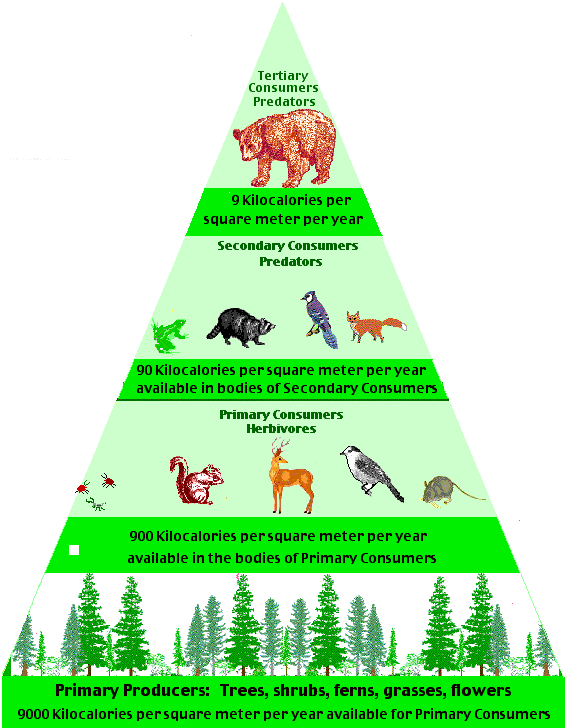 This is a pyramid of numbers
the producers are the trees and shrubs
the first order consumers are the herbevores are the deer, squirell, mice and etc.
the second order consumer are the predators such as foxes bigger birds and etc.
the third order consumer is the biggest predator in this biome, the bear
Selasa, 01 April 2008

1. The Owls will either eat them or they will be over populated
2. All the toads will die and there will be more predacous insects
3. The insectovourus birds will die and all the predacous insect can only eat herbivorous insects
4. They would be able to eat a LOT more
5. It would be a lot harder for them to look for food
6. foxes and owls and hawks
7. rabbits and mice
8. snakes and foxes
Langganan:
Postingan (Atom)